Biodiversity monitoring programmes, particularly those focusing on birds, have evolved considerably in recent years. In many cases, traditional fieldwork has been supplemented or partly replaced by algorithms and artificial intelligence. Innovative technologies such as passive acoustic monitoring (PAM), in which microphones record birdsong that is subsequently identified automatically, are becoming increasingly important in ecology. Their greatest advantages are the large volume of data they can collect and the extended periods over which observations can be made. At the same time, however, this abundance of data presents new challenges, meaning that the results must be interpreted with appropriate caution.
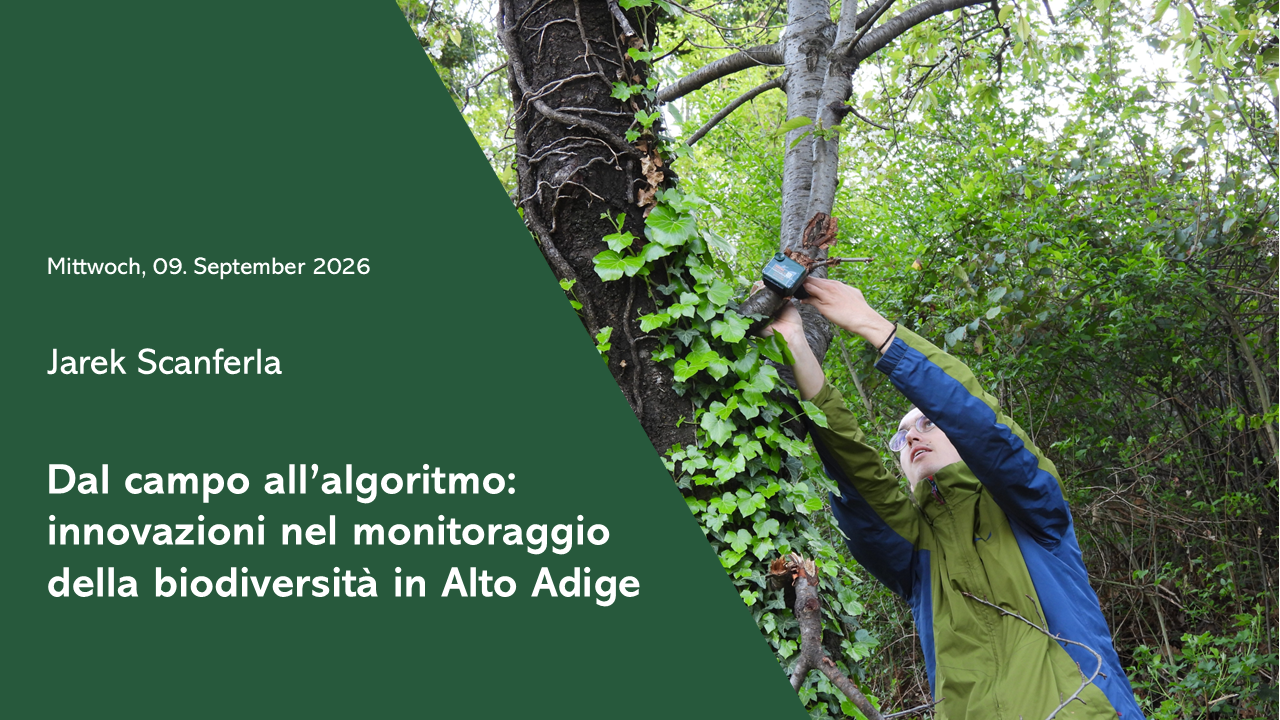
As a growing number of monitoring programmes adopt PAM, it is essential to understand how comparable this method is to traditional monitoring. For this reason, the Institute for Alpine Environment incorporated passive acoustic bird monitoring into the Biodiversity Monitoring South Tyrol (BMS) programme in 2024. By combining traditional point-count surveys with microphones deployed in the field, we are investigating how effective these new and innovative monitoring methods really are. After three years of data collection, we compared and analysed the diversity indices obtained using both methods.
Although this presentation focuses primarily on birds, the speaker will also introduce new monitoring approaches for other groups of organisms, including moths and bats. The aim is to provide a better understanding of these new technologies and to critically discuss their use, as well as the future roles of traditional field ecology and field ecologists.
Jarek Scanferla, a biologist and ornithologist, works at the Institute for Alpine Environment at Eurac Research in Bolzano. His work focuses primarily on surveying South Tyrol’s birdlife, Alpine ecology and modern monitoring methods.
The colloquium will be held in Italian.
The event can also be followed online on the Museum’s YouTube channel.